The Current Advanced Air Mobility Ecosystem
Advanced Air Mobility (AAM) is rapidly evolving from a futuristic concept into a real and growing ecosystem that is beginning to reshape how we think about transportation, logistics, and aerial services. At its core, AAM is not only about new types of aircraft, such as electric Vertical Take-Off and Landing (eVTOL) vehicles, but also about the safe and efficient use of urban airspace to enable new forms of mobility and aerial operations, where different types of aircraft, including drones (UAVs), can operate together.
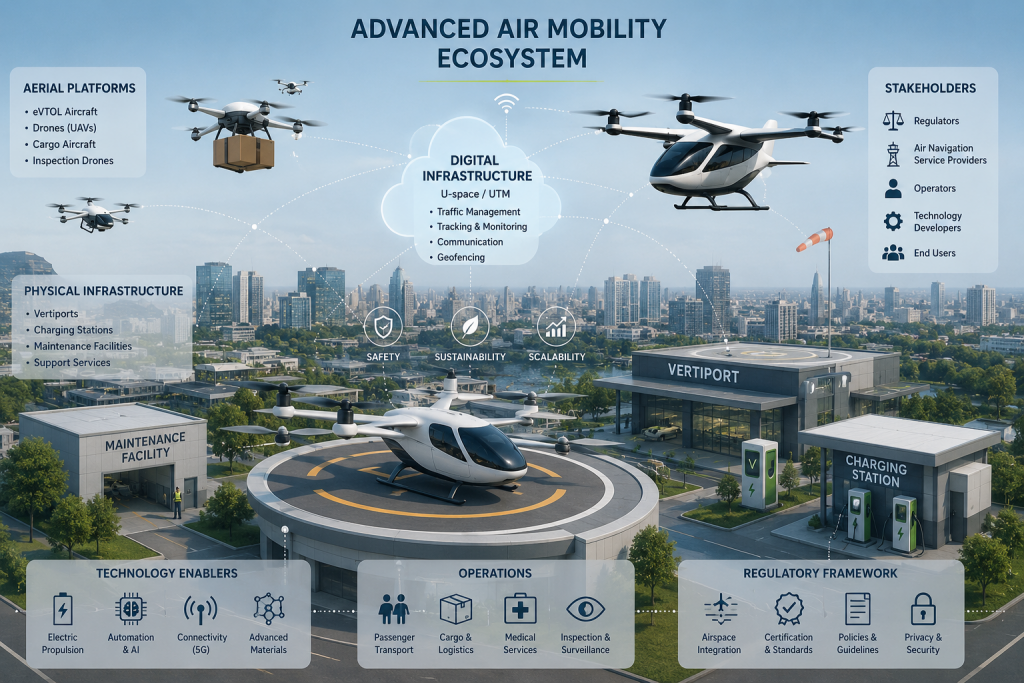
Today, the AAM ecosystem is made up of several interconnected components. First, there are the aerial platforms themselves, ranging from small drones used for inspections and deliveries to larger e-VTOL aircraft designed for urban passenger transport. These vehicles are becoming more capable thanks to advances in electric propulsion, automation, and onboard intelligence.
Equally important is the supporting digital infrastructure. Systems such as U-space in Europe are being developed to manage increasing drone traffic safely and efficiently. These systems allow multiple aircraft to operate in shared airspace by providing services such as tracking, communication, and traffic coordination. This is essential as the number of aerial operations continues to grow.
Another key part of the ecosystem is physical infrastructure, including vertiports (designated areas for take-off and landing), charging stations, and maintenance facilities. These enable the practical deployment of AAM services, particularly in urban environments where space and safety are critical considerations.
The ecosystem also includes a wide range of stakeholders: regulators, air navigation service providers, technology developers, operators, and end users. Collaboration among these groups is crucial to ensure that AAM systems are safe, scalable, and aligned with societal needs. Regulatory frameworks are evolving in parallel with technology, helping to define how these new aircraft can be integrated into existing airspace.
European projects like EUSOME (EUSOME: Transforming Advanced Air Mobility in the Southeast Mediterranean region through technological advancements) play an important role in this landscape by developing and testing the technologies and concepts that will shape the future of AAM. This multidisciplinary approach is essential in AAM, where technological development must align with regulatory frameworks, operational constraints, and societal needs. By bringing together research, industry, operational expertise, stakeholders, and end-users, such initiatives help bridge the gap between innovation and real-world deployment.
In summary, the AAM ecosystem is not just about new aircraft; it is about creating a fully integrated system where technology, infrastructure, and regulation work together. As this ecosystem continues to mature, it holds the potential to transform multiple sectors and redefine mobility in the years to come.