Understanding the EU U-space Framework and Its Role in Advanced Air Mobility
As drone operations continue to expand across Europe, from infrastructure inspections to medical deliveries, the need for a structured and safe way to manage increasing air traffic becomes more important than ever. This is where the EU’s U-space framework comes in.
U-space is a set of services and procedures designed to enable the safe, efficient, and secure integration of drones into European airspace, especially in areas where traffic is dense or operations are complex. It is a key building block for the future of Advanced Air Mobility (AAM), where drones and other uncrewed aircraft will operate routinely in urban and suburban environments.
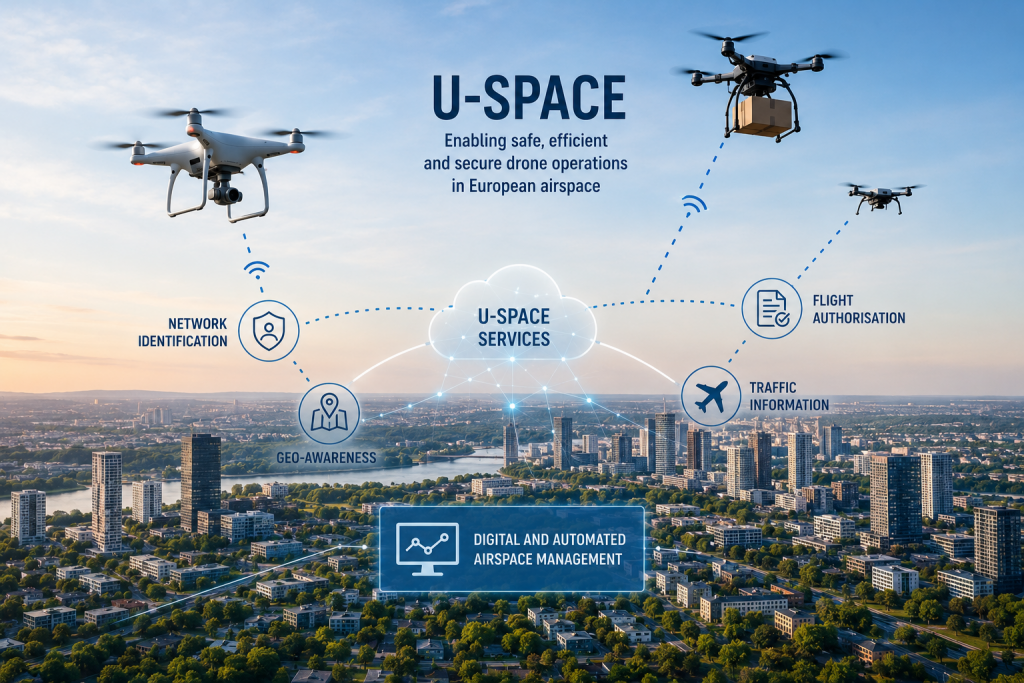
At its core, U-space aims to ensure that drone operations can scale without compromising safety. It introduces a digital, service-based approach to airspace management, where operators, service providers, and authorities are all connected through shared systems. Some of the fundamental services include network identification, geo-awareness, flight authorisation, and traffic information, allowing drones to operate beyond visual line of sight (BVLOS) in a controlled and predictable way.
One of the most important aspects of U-space is that it shifts drone operations from being mostly isolated and manual to becoming highly automated and interconnected. This is essential for AAM use cases such as drone delivery, emergency response, and urban air transport, where multiple operations may take place simultaneously in the same airspace.
The regulatory foundation for U-space has already been established at the European level, with Member States now moving towards national implementation. This includes the designation of U-space airspace, certification of service providers, and integration with existing air traffic management systems. However, practical deployment still comes with challenges, such as ensuring interoperability between systems, managing cybersecurity risks, and achieving public acceptance.
From a broader perspective, U-space is not just a technical or regulatory framework, but it is an actual enabler of new services and business models. By providing the structure needed for safe and scalable drone operations, it opens the door to applications that can bring real societal benefits, including faster medical logistics, more efficient infrastructure monitoring, and reduced environmental impact in certain transport scenarios.
As Europe moves forward with the implementation of U-space, collaboration between industry, authorities, and research initiatives remains essential. The EUSOME project contributes to this effort by exploring how digital technologies, connectivity, and operational concepts can support the next generation of air mobility.
In this context, understanding U-space is not only important for aviation stakeholders, but for anyone interested in how drones will become part of everyday life in the near future.